He Refused To Serve A Barefoot Marine — The Biker In The Corner Booth Made Him Pay
My boss told a barefoot Marine to take his begging out into the parking lot. The biker in the corner booth set his coffee down very slowly.
“Sit down, Marine. You’re not getting a dollar. You’re getting this.” The biker pushed a steaming plate of steak and fries across the booth — and my manager Carl froze with the phone halfway to his ear.
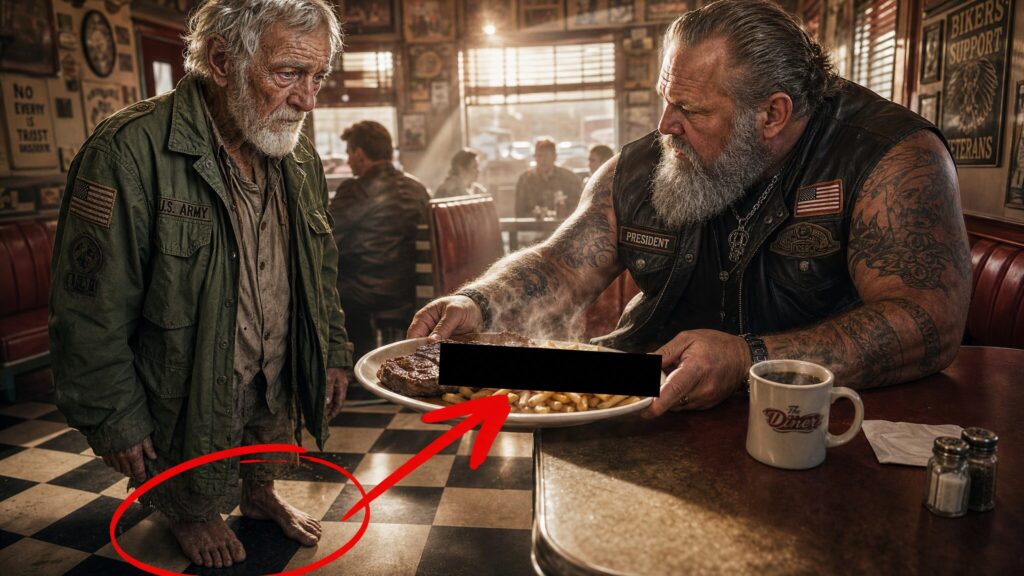
I’d been pouring coffee at table eleven when the old man shuffled in. Henry. That’s what he’d called himself the first time I’d given him a refill on the house, three weeks earlier. Henry, with his frayed olive field jacket and his bare feet on our checkerboard floor.
He never asked for much. Just somewhere warm. A coffee if anyone was buying.
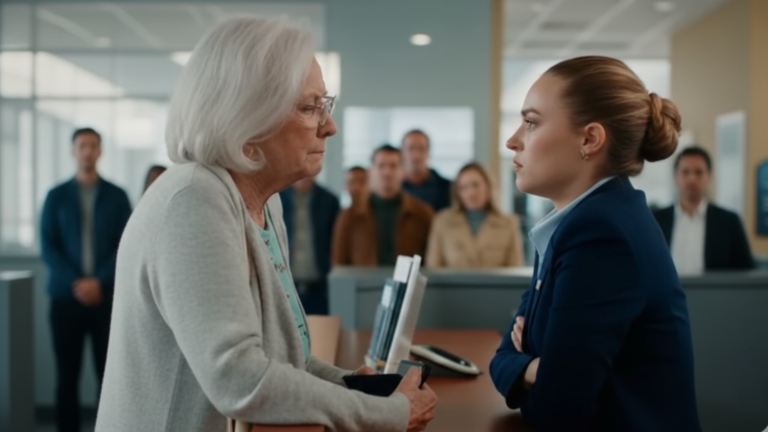
“Out. Now.” Carl was moving toward him before the bell over the door even stopped jingling. “I told you last week. You can’t be in here.”
“I’m sorry, sir, I just — “
“I don’t care. Out.”
Henry’s hands were shaking. I’d watched him cross the parking lot in February asphalt. No socks. No shoes. Just a thousand-yard stare and a jacket two sizes too big.
That was when the man in the corner booth set down his coffee.
I hadn’t even noticed him come in. Big guy. Long iron-grey beard. Leather vest. He moved without hurry — the kind of slow you only see in men who don’t have to prove anything anymore.
“Hold on, partner.”
Carl turned around. “Sir, this is between me and — “
“It’s not.” The biker walked past him and put one hand, gently, on Henry’s elbow. “Come on. Sit with me.”
“Excuse me. Sir. He’s not a customer.”
“He is now.” The biker pulled out a fifty and dropped it on my tray without looking at Carl. “Whatever he wants. Plus pie. Plus a steak. Keep the change.”
Carl stared at the fifty like it had teeth.
“And another coffee for me, when you’ve got a second.”
He walked Henry to his booth like he was walking him across an ice rink. Sat him down across from himself. Snapped his fingers at me, but kindly.
“Miss. Bring him whatever’s hot. And socks. There’s a drugstore two doors down. I’ll cover that too.”
I just nodded.
“Excuse me.” Carl had found his voice. “Sir. I’m the manager. I make those decisions, and that man does not eat in this restaurant.”
“Why’s that?”
“He bothers customers.”
“He’s the only one in here right now. Other than me.” The biker leaned back. His vest fell open. I saw the patches.
PRESIDENT, in white letters on a red banner. Above it: an eagle, globe, and anchor. Marines.
Then a smaller patch I won’t write the name of — but every man at every veterans hall within fifty miles would know it on sight.
Carl saw it too. He didn’t move.
“Now,” the biker said, voice still calm, “you can either bring me my coffee and bring my brother here a meal — and a pair of socks. Or you can keep talking, and we can find out how the rest of my chapter feels about a man who throws barefoot Marines into a February parking lot. Your call.”
Carl made his call.
He turned, walked behind the counter, picked up the phone, and started dialing.
That’s when the biker said it.
“Sit down, Marine. You’re not getting a dollar. You’re getting this.” He pushed the plate Carl had abandoned across the booth — someone else’s lunch, untouched, still steaming. “Eat. Slow. You’re safe here.”
Henry’s hands shook so hard the fork rattled on the plate. He looked at the biker for a long time before he picked it up.
“What’s your name, son?”
“Hawk. Hawk Reilly. First of the Ninth. Khe Sanh, ’68. You?”
Henry’s eyes filled.
“Henry Boyd. Third Marines. Hue City, ’68.”
Hawk closed his eyes for one full second. Then he opened them and squeezed Henry’s hand once, firm, and let go.
“Eat, brother. Then we talk.”
Carl was still on the phone.
“Hi, yes, the police? I have a vagrant refusing to leave my — “
“Carl.” I don’t know where I found my voice. “Put the phone down.”
Carl looked at me like I’d grown a second head. “Stay out of this, Megan.”
“He’s a customer.”
“He is not a — “
“He’s sitting in a booth. He’s been served. He’s a customer.” I pulled the order pad out of my apron. “And Carl? You touch that phone one more time, you’re calling them on me too. Because I am not standing here for this.”
Hawk did not look up from his coffee.
“Smart girl.”
The bell over the door rang again.
I will remember the next four minutes for the rest of my life.
They came in twos. Then threes. Then fours. Big men. Some women. All in leather. All with the same Marine Corps patch on their backs. The diner had thirty-eight seats. By the time the bell stopped jingling, every one of them was occupied, and there were still men standing.
Carl had hung up the phone. He hadn’t moved since.
Hawk finally turned his head.
“You called your chapter?” I asked.
“Didn’t have to. We ride to lunch every Tuesday. Two minutes out anyway. Nice place, this. Big windows.”
He smiled at Carl for the first time. It was not a friendly smile.
“You were saying something, sir? About who eats in this restaurant?”
Carl opened his mouth. Closed it. Opened it again.
“I — there’s been a — misunderstanding.”
“There has.” Hawk stood up. He was taller than I remembered. “Here’s how we’re going to clear it up. Henry eats here. Today. Tomorrow. Whenever he wants. On the house. And if you push back on that, I will personally make sure every veterans organization in this county and the next three knows what kind of place you run.”
“Sir, I — “
“I’m not done.” Hawk reached into his inside pocket and took out a small spiral notebook. “Greg over there has been filming since I walked over. So’s Linda. So is Tommy. So when I tell you that what just happened is going up on every page we own — and we own a lot of pages, Carl — and your corporate office will be getting a copy of it by close of business, I want you to understand it’s already done. It’s not a threat. It’s a notification.”
Carl had gone the color of wet paper.
“Now. About Henry.”
“Sir, I cannot — I have a policy — “
“Your policy is overruled. By me. By them. By the eighty-six pounds of dog tags between us in this room.”
Carl looked at me. Looked at the room. Looked back at Hawk.
“Sit, Marine,” Hawk said again, gentler now, to Henry. “Eat. Take your time. We’ve got all afternoon.”
Henry ate.
He ate slowly, the way you eat when you haven’t trusted a hot meal in a long time. Hawk watched him eat. He didn’t say a word for ten minutes. He just watched, the way you watch a fire to make sure it doesn’t go out.
When Henry finally set his fork down, Hawk reached across the table and put his hand on his wrist.
“Got a place to sleep tonight, brother?”
Henry shook his head once.
“You do now.”
That was nine months ago.
Henry sleeps in a transitional apartment Hawk’s chapter cosigned for. He has a case worker. He has a haircut. He has shoes. He helps out at the chapter clubhouse on weekends — sweeps the floor, makes the coffee, tells the younger guys about Hue City when they ask, which is often.
Carl got fired the following Monday. The corporate office got eleven separate copies of the video before lunch. Two of the customers in the diner that day were corporate-level franchise reviewers. Carl didn’t know that. Neither did I.
The diner closed four months later. Couldn’t recover from the reviews. Couldn’t recover from losing the Tuesday lunch business of thirty bikers. Couldn’t recover from the lawsuit Henry’s pro-bono lawyer — a member of Hawk’s chapter — filed for the prior incidents on record.
I quit the day after Carl was fired. The new manager begged me to stay. I said no.
I work at the chapter’s veterans outreach office now. Three days a week answering phones. Two days driving Henry and the other older guys to their VA appointments. Hawk pays me more than Carl ever did, and at five p.m. he tells me to go home.
Last Tuesday Henry came into the office in shoes I had picked out for him. He was wearing a clean shirt. He was holding a small wrapped box.
“For you,” he said. “Late thank-you.”
I opened it. Inside was a small pin — an eagle, a globe, an anchor. Honorary, he said. From the boys.
I have it on my jacket. I wear it every day.
Hawk says you don’t earn a pin like that. He says somebody earns it for you, and then you spend the rest of your life trying to deserve it.
I’m trying.