A Crying Boy Walked Up To Thirty Bikers In The Desert — Then He Held Out A Toy I’d Lost In 2010
A barefoot kid walked across a desert highway straight at thirty bikers… What he held in his hands was the silver toy I’d given my son the day before they took him from me
The boy held something out to me with both hands shaking. I’d given that exact thing to my son fifteen years ago, the day before they took him from me.
We were ninety miles east of Barstow when one of my guys hit the brakes. Thirty bikes idling on a stretch of cracked desert highway, the heat coming off the asphalt in waves.
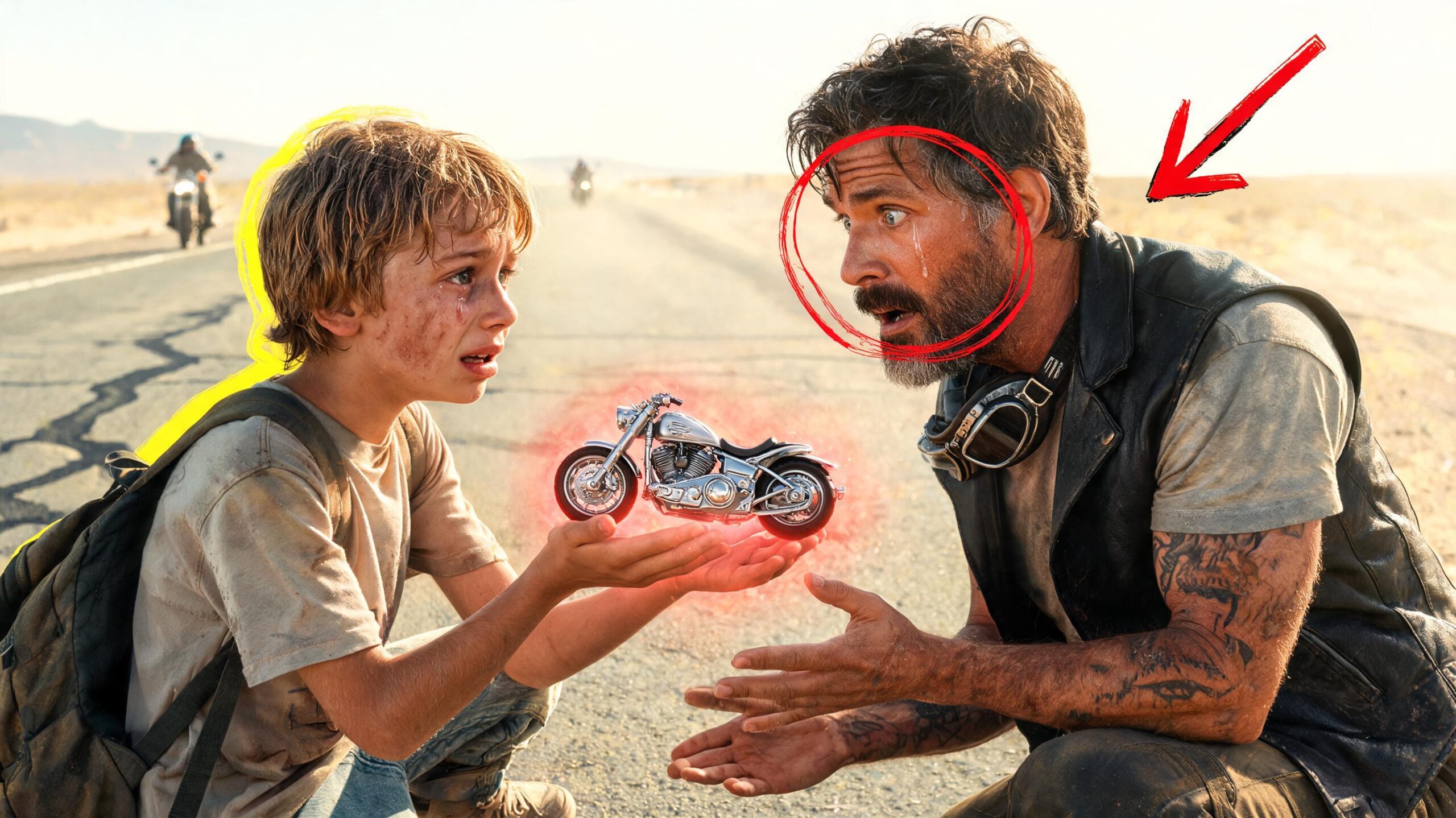
A kid was walking on the shoulder. Alone. Maybe ten years old. Sneakers white with dust, a stuffed backpack with one broken strap, eyes red-raw from crying.
“He’s been walking a while,” my road captain Diaz said behind me. “Want me to call it in?”
I told him to wait.
I cut the engine and dropped the kickstand. The kid stopped twenty feet from us, breathing in jerks. Every man behind me went still — bikers know when to read a moment.
I walked out slow, hands open. “You okay, son?”
He shook his head. Then he reached into his backpack and pulled something out, lifting it toward me with both hands.
A small silver toy motorcycle. Detailed down to the spokes. A chip of red paint missing from the tank. The exact one I’d dropped off at a courthouse lobby fifteen years ago, wrapped in a red ribbon, on the day I lost everything.
I didn’t move for a second. Couldn’t.
“Where did you get this?” My voice came out wrong.
“From my mom.” His chin trembled. “She said when she’s gone, I should find you.”
“Who’s your mom?”
He swallowed hard. “Mara Halloran.”
I went down on one knee on the asphalt. The kid flinched like he thought I was going to grab him. I made my hands stay open at my sides.
“What’s your name?”
“Caleb.”
I’d practiced what I’d say to him for fifteen years. Every version of it left me. I just looked at his face — his mother’s nose, my jawline, my little brother’s eyes — and I felt my throat close.
I pulled my goggles down to my neck so he could see me. “Hey. Hey, buddy.”
“Are you my dad?”
“Yeah.” I had to say it twice. “Yeah, son. I’m your dad.”
He came forward in three short steps and folded into me. Skinny arms around my neck. Smelled like a bus station and three nights of no shower. I didn’t move for a long time.
Diaz had walked up behind me at some point. I heard him say to the rest of the guys, very quietly, “Kill the engines.”
Thirty bikes went silent.
We sat on the open tailgate of a chase truck. I gave him a water bottle. His backpack held a sandwich bag with two granola bars, a stuffed elephant, an envelope, and a photograph of a younger man holding a baby. The man in the photograph was me at twenty-three. Mara had written my name on the back in blue pen.
“How long you been on the road, Caleb?”
“Six days.” He bit a granola bar in half. “I took a Greyhound from Tacoma to Vegas. The man at the station gave me money for the ticket.”
“Your mom?”
He stopped chewing. “She got sick last year. She died in October.”
“Where’s your stepdad?”
A long pause. “He told me I wasn’t his problem anymore.”
I had to set the water bottle down because my hand wasn’t working. Diaz heard him say it. Diaz is a quiet man. He turned and walked twenty paces away and broke a chunk off the embankment with his boot.
“He left you?” I said.
“He drove me to a McDonald’s parking lot and didn’t come back.”
“How long did you wait?”
“All night.”
I closed my eyes. When I opened them I held my hand out for the envelope.
It was Mara’s handwriting. Older, shakier than I remembered, but hers.
Cole — I’m sorry. I was wrong. He has been asking about you since he was four. I always told him he had a father who loved him and one day they would meet. The day was supposed to be later than this. Please be the man I wouldn’t let you be. — M.
I read it three times before I could stand up.
I called my sister Reagan in Boise. She’s been a county social worker for sixteen years.
“Reagan. Sit down.”
“What.”
“Mara died. Caleb is with me. He’s been living in his stepdad’s car at a McDonald’s. I need emergency guardianship and I need it tonight.”
She didn’t ask a single question. I could hear her start typing while I was still talking.
I called my lawyer, Bill Oakes, on speaker so Diaz could listen. Bill picked up on the third ring.
“Cole.”
“Bill, I have my son.”
He went very still on the other end. “Where are you?”
“Mojave. Highway 58.”
“Drive him to a hospital. Have him examined. Document everything. I’ll have an emergency motion filed in San Bernardino County Superior in two hours. Cole — listen — do not let anyone take him from you tonight. He stays in your physical custody until a judge says otherwise.”
“Understood.”
I hung up.
I looked at Caleb. He was watching me with eyes that were too old for ten.
“You’re staying with me,” I said. “Forever. Do you understand what I’m telling you?”
He nodded. Then he looked down at the toy in his hands.
“Mom said you’d remember it.”
“I remember it.”
“She said you carried it everywhere when you were a kid.”
“I did.”
“She said you gave it to me on my fourth birthday.”
“That’s right.”
He held it back out to me. “She said when I found you, I should give it back. Because you’d been keeping it for me.”
I took it. Still had that one chip of red paint missing from the tank. I closed my hand around it for a second. Then I put it back in his palm and folded his fingers shut over it.
“You keep it, son. It’s yours.”
The hospital cleared him at sundown. Malnourished, dehydrated, two scabbed-over scrapes on his shins. Otherwise whole.
A judge in San Bernardino granted emergency guardianship at 11:14 that night by phone. Bill earned every dollar I’d ever paid him.
Reagan flew down on Tuesday. The DA’s office in Tacoma was filing felony child-abandonment charges against the stepfather by Friday. Six weeks later he pled to four years.
I sold the house in Sacramento in November. Moved to Boise and bought a small bike-repair shop two blocks from Caleb’s new school. Reagan’s the named co-guardian; she’s three streets over from us.
I stepped down as president of the club the day Caleb’s permanent custody came through. Diaz took the patch. He gave me his old patch back and told me to put it in a drawer for my son if he ever wanted it.
It’s been fourteen months.
Caleb has friends now. He has a dog named Patch. He has a bedroom with a state-college poster on one wall and that silver toy motorcycle on the dresser, exactly where I can see it from the hallway every morning.
He calls me Dad. He started in February. I didn’t ask him to.
I waited fifteen years to be his father. I’m not wasting one more day of it.