The Heiress Thought Her Daughter Died In 1996 — Until She Saw What Her New Maid Was Wearing
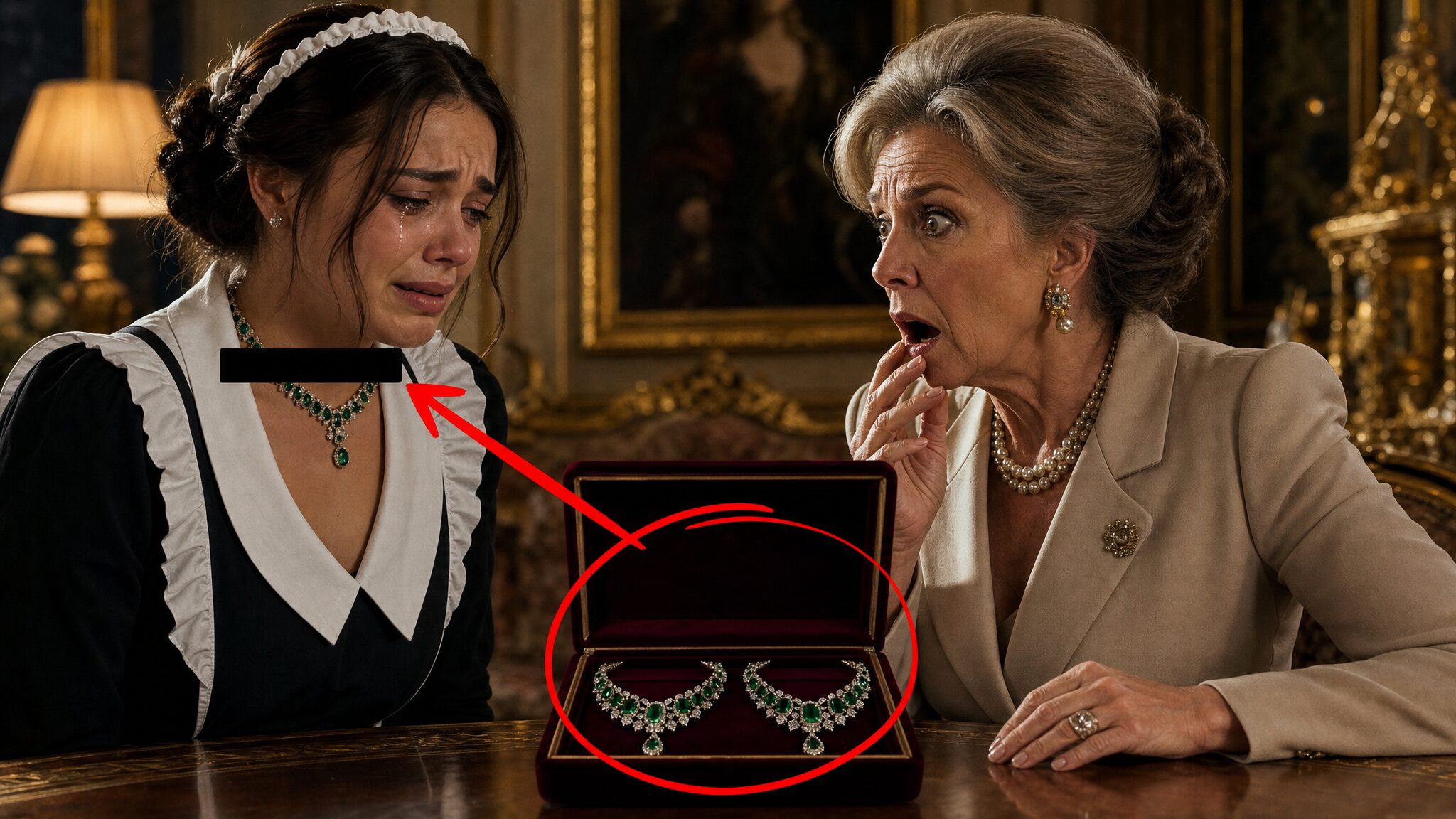
My new employer accused me of stealing the necklace my mother left me… Then she opened a velvet box on her desk and showed me two more exactly like it.
“Take it off,” she said, before I had even set down the silver tray. “That necklace doesn’t belong to you.”
Mrs. Whitmore was standing at the far end of the drawing room, one hand braced on the back of a wing chair, knuckles gone white against the brocade. I had been in her employ for eleven days. I had not yet heard her raise her voice for anything — not for the broken porcelain in the south parlor, not for the gardener who let the orchids freeze. Her voice now was very quiet. That was worse.
“Ma’am?” I said.
“The necklace.” Her eyes were locked on my collar. “Take it off, and tell me exactly where you got it.”
I touched the pendant without thinking — the small habit of a girl who had touched it every day for sixteen years. Emerald the size of a peppercorn. Tiny diamonds in a halo around it. Pale-gold chain that caught the morning light through the leaded glass.
“It was my mother’s, ma’am,” I said. “She gave it to me before she died.”
Mrs. Whitmore did not move. “Your mother.”
“She passed away when I was seven. The necklace was the only thing she left me.”
For a long moment, Mrs. Whitmore did not answer at all. Her gaze stayed fixed on my throat. Then, slowly, she crossed to the polished walnut desk in the corner of the room, opened the top drawer with a hand that was not quite steady, and lifted out a small velvet box the color of dried blood.
She set the box on the desk between us.
“Come here,” she said.
I came. The tray was still in my hands. I did not know what to do with it. She did not seem to see it.
The box was older than I was. The leather corners were worn pale. The velvet lid was creased from decades of being opened and closed by the same fingers.
She lifted the lid.
Inside, on cream-colored silk, lay two emerald-and-diamond necklaces. Identical to mine in every detail. The same emerald cut. The same diamond pattern. The same pale-gold chain. Three necklaces, where there should have been one.
I felt the room tilt under my shoes.
“Ma’am,” I whispered. “I have never seen these before.”
“I had three made.” Her voice was strange now. Not angry. Something quieter and far worse. “When my daughter was born. One for her, one for me, one for an heirloom. I kept the heirloom in this drawer. I wore mine to her christening.” She lifted her eyes. They were not on the box anymore. They were on me. “And the third I pinned to her sleeper the night she was born.”
“I don’t —”
“What was your mother’s name?”
I had to wet my lips before I could answer. “Margaret.”
Her hand on the desk closed into a fist.
“And when was she born?”
“March fourteenth,” I said. “Nineteen ninety-six.”
Mrs. Whitmore’s knees folded. She did not fall — she sat herself down on the edge of the desk like the floor had given way beneath her and she had decided to meet it on her own terms. The fist did not unclench. A single tear cut down across her cheekbone and stopped at the corner of her mouth, where she did not wipe it away.
“On March fifteenth, nineteen ninety-six,” she said, in a voice I had never heard her use, “I buried a daughter. A daughter named Margaret. Who, according to my husband and my husband’s lawyer, was lost in her crib the night she was born.”
The walls of the drawing room seemed to move an inch closer.
“Mrs. Whitmore —”
“Eleanor.”
“Eleanor.”
“Was your mother adopted?”
“I —” I shook my head. “She never said anything like that. She told me — when she gave me the necklace, before she died — she said it had been given to her by my real grandmother. She said one day I would find her.”
Eleanor closed her eyes. When she opened them, the woman who had accused me of theft was gone. What stood in her place was something older and harder and terribly, terribly awake.
“We are going to a clinic,” she said. “Today. And then we are going to my attorney. Not the one who served my husband. A different one. One I should have hired thirty years ago.”
The DNA test took four working days.
I stayed in the staff quarters because I did not know where else to go. Eleanor told the household I had taken bereavement leave. She did not tell them whose. She brought me dinner herself the second night, on a tray she carried in her own hands. We did not speak for most of the meal. When she stood to leave, she touched the back of my chair.
“My daughter would be twenty-eight,” she said. “If she had lived.”
“My mother died at thirty,” I said. “She had me at twenty-two.”
She closed her hand on the chair, then on nothing, then walked out.
On the fifth morning, she came to my door before sunrise. She was holding a single sheet of paper.
“Ninety-nine point nine eight percent,” she said. “You are my granddaughter.”
I sat down on the bed.
She sat down next to me. We were both very straight, very still. The light was barely up over the lawn.
“Your mother,” she said, and her voice cracked open on the word, “did not die in any crib I ever stood beside. My husband’s lawyer placed her with a family in Springfield three days after she was born. Charles paid him. I did not know.”
“My mother never knew either,” I said. “She thought her — her adoptive parents — were her real ones.”
“And the necklace?”
“She found it sewn into the lining of a baby blanket when she was a teenager. There was a note. The note said the necklace came from her real mother.”
“It did,” Eleanor said. “I pinned it to her sleeper the night she was born. I touched it every time I changed her.”
We sat on that bed in the quiet for a long time. Outside the window the first birds started up over the kitchen garden. Eleanor reached into her cardigan and brought out a small folded handkerchief. She did not use it. She just held it.
“Twenty-eight years,” she said.
“I know,” I said.
She turned her face toward me.
“You have her chin.”
Edward Barrows had been the Whitmore family lawyer for forty-one years. He still kept the corner office on the eighteenth floor of the firm that bore his name. He was still using the same fountain pen he had used the night he signed Margaret’s faked death certificate.
Eleanor walked into his office without an appointment. I walked in two steps behind her. The receptionist tried to stop us. Eleanor did not look at her.
“Edward,” she said, setting the velvet box down on his desk with a small, deliberate click. “I would like to introduce you to my granddaughter.”
Edward looked at the box.
He looked at the box for a very long time.
“Eleanor,” he said, finally. “Whatever you think you have —”
“I do not think anything.” She lifted the lid. The two necklaces glittered up at him under the office lights. “I have a DNA result. I have a baby blanket. I have a name. I have a date of birth. I have a paper trail that begins, Edward, in your handwriting.”
His mouth opened. Closed. Opened again.
“Charles —” he began.
“Charles is dead. You are not. We are going to talk about the difference.”
“Eleanor, please. He was — there were circumstances —”
“I am sure there were.” Her voice did not rise. It only got colder. “You will explain those circumstances to a prosecutor. You will explain them in front of a judge. You will explain them, eventually, to my granddaughter, who, as it happens, is right behind me, and who has waited her entire life to hear them.”
He looked past her then. He looked at me.
I did not say anything. I did not need to. The necklace at my throat said all of it.
Edward Barrows is sixty-eight years old. He pleaded guilty to fraud, forgery, and conspiracy in the unlawful placement of a minor. The plea cost him his license, his pension, and his liberty for what the judge called “the foreseeable balance of his natural life.” The bar disbarred him within the week.
Eleanor’s revised will was filed within the month. It names me, by both my given name and by my mother’s name, as the sole heir of the Whitmore estate. The wing chair where she stood that first morning is still in the drawing room. So is the desk. So is the velvet box.
I still wear the necklace my mother left me. Eleanor wears the one she pinned to a sleeper in March of 1996 and never took off again. The third — the heirloom — sits in the velvet box in the top drawer of the polished walnut desk, waiting for the next girl in our family to grow into it.
When I touch my pendant now, I think of all the years my mother touched hers and didn’t know whose hand had clasped it on her first.
I tell her, in my own way. Every time.
I tell her we found each other.