My Wife Threw Our Daughter A Gala — A Dirty Kid Ended It
My wife organized a six-million-dollar charity gala for our disabled daughter… A twelve-year-old boy in a stained hoodie walked in and proved that the disability was her doing.
Everyone at the gala thought my daughter’s wheelchair was the tragedy of the evening. None of them knew what the dirty kid in the back of the hall was about to prove with three amber pill bottles.
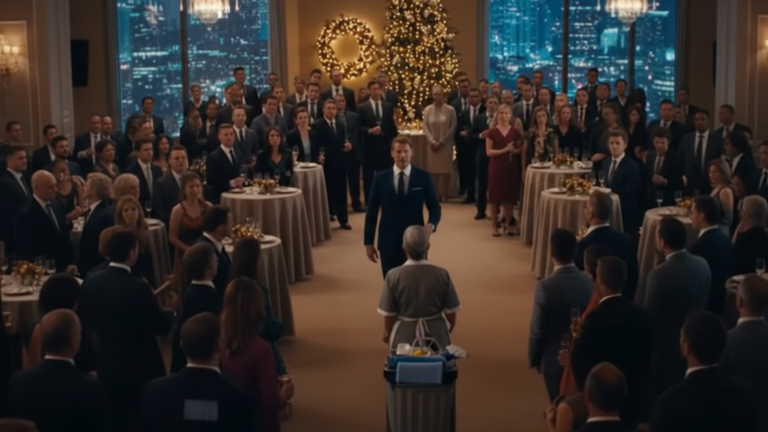
My name is James Whitman. That night — April twelfth — was supposed to be the biggest fundraiser of my life. Six million dollars pledged on paper. Three hundred guests in the ballroom of the Ashford Hotel. And at the center of it, my eleven-year-old daughter Emma, in a cream silk dress, in a wheelchair she had been in for four years.
My wife Victoria had planned every detail.
“Smile, sweetheart,” she said, smoothing Emma’s hair. “This is all for you.”
Emma smiled the same tired smile she always did. Her hands were so thin I could see the tendons.
I was at the microphone thanking the board when I saw him.
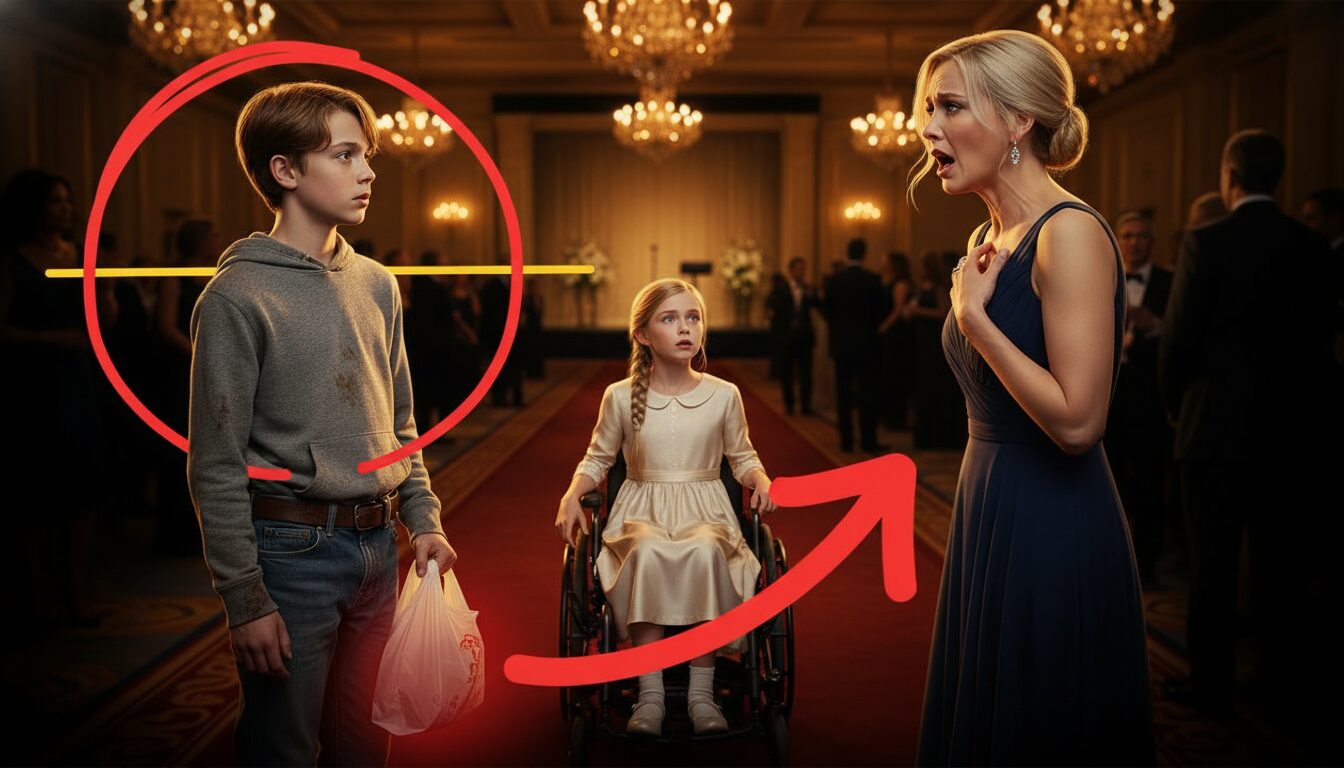
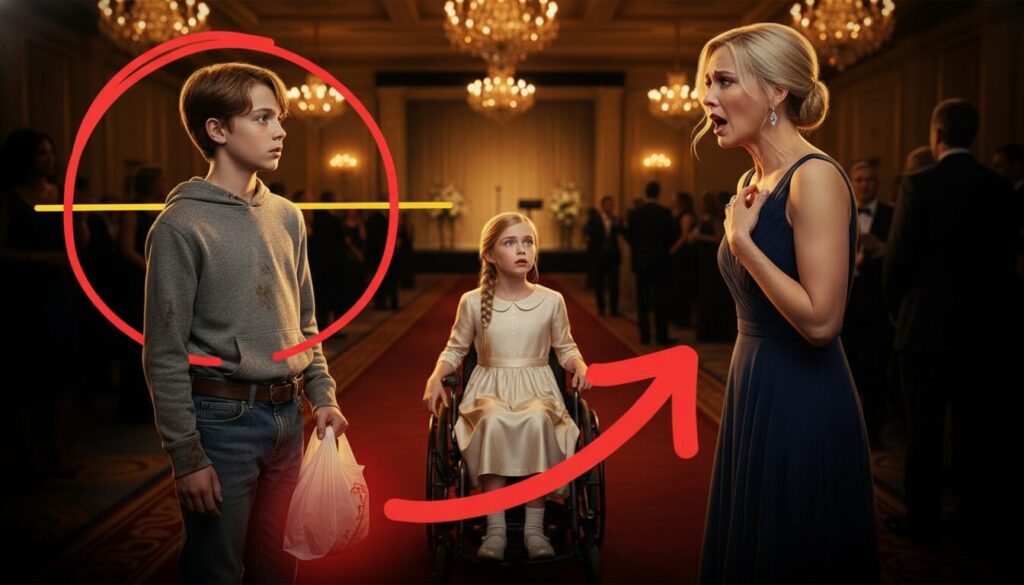
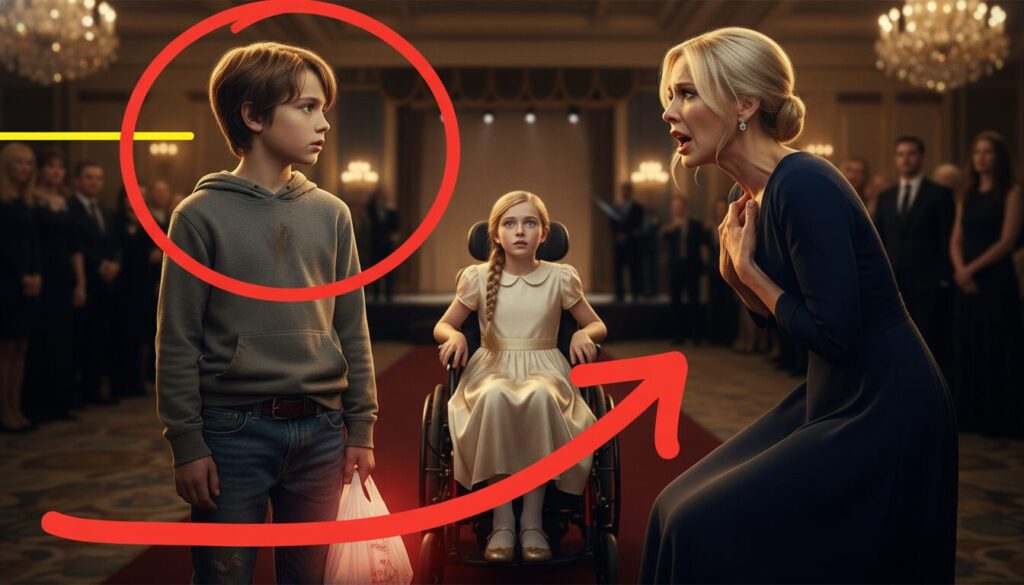
A boy — maybe twelve, maybe thirteen — in jeans three sizes too big and a hoodie stained at the cuffs, walking down the center aisle with a plastic grocery bag in his hand. He walked past two of my security like they were furniture.
The waitstaff tried to cut him off. He slipped around them. The room started to notice.
He walked to Emma’s wheelchair and crouched down to her eye level.
“Hi,” he said. “I know why you can’t walk.”
Victoria came off the dais so fast she almost tripped on her own hem.
“Don’t listen to him, baby.” Her voice was an octave higher than I had ever heard it. “Security — get this filthy animal out of my hotel. Now.”
The boy didn’t flinch. He stood up straight. His voice was perfectly calm.
“Sir,” he said, looking at me. “Your wife is the reason your daughter is in that chair.”
Three hundred people went silent at the same time.
I walked down from the dais like I was walking underwater.
“What did you just say?”
“Open the bag,” he said.
I took the grocery bag out of his hand. Three amber prescription bottles. Dates on the labels going back two years.
Victoria’s manicured hand closed on my wrist. “James. He’s a child. He’s sick in the head, someone put him up to this, I want him removed—”
“Who is his mother?” I asked her.
Her hand froze.
“Who is his mother, Victoria.”
The boy answered for her. “Her name is Denise Hollis. She worked at Ashford Pharmacy for nine years. She filled my sister’s prescriptions her whole life. She filled yours too, sir.”
I remembered Denise. Mid-fifties. Kind eyes. Fired eighteen months ago for “prescription mishandling,” according to Victoria, who had insisted we switch pharmacies after.
I picked up the first bottle.
The patient name read Emma Whitman. The medication name did not read Keppra.
It read Baclofen. Twenty milligrams. Three times a day.
Dr. Kellerman’s voice came back to me from the last neurology appointment. Her seizures are well-controlled, but the motor regression is unusual. I want to double-check what she’s actually metabolizing. I had nodded and shaken his hand and gone back to my life.
I looked up at my wife. Three hundred people were watching her face.
Her mask didn’t crack all at once. It came apart in pieces. The jaw first. Then the eyes.
“James,” she whispered. “James, please—”
“Baclofen,” I said. “You’ve been giving her Baclofen. For four years.”
“I can explain — James, she needed—”
I held the bottle up to the light. My hand wasn’t even shaking.
“You told her doctor she was having seizures she wasn’t having. You told me her legs were getting worse because the disease was progressing. You told every pediatric neurologist in three states the same story. And you were feeding her a high-dose muscle relaxant. For four years.”
Victoria’s knees started to buckle. A waiter caught her elbow on reflex, then realized who he was holding and let go.
The boy pulled a small spiral pad out of his hoodie pocket.
“My mom wrote down every time Mrs. Whitman came in and asked her to change the label,” he said. “Mom said no the last time. That’s why she got fired.” He looked at me. “Mom has pictures too. Of the bottles. Before and after.”
Victoria lunged for the notebook. My head of security — a former FBI agent named Marcus — stepped between her and the boy without being asked.
“Don’t touch him,” Marcus said.
I had never heard Marcus use that voice on my wife.
I took my phone out of my tuxedo jacket and called Elliott, my lawyer, on speaker.
“Elliott. It’s James. I’m at the Ashford. I need you here in twenty minutes. I also need you to call Detective Rourke at SFPD. My wife has been poisoning my daughter for four years and I have the pharmacy records and a witness. Yes. I’m serious. Yes. Now.”
I hung up.
“James—” Victoria tried again.
“Don’t.”
I turned to the room. Three hundred people in black tie, frozen. Cameras, phones, the live-stream crew from the foundation.
“Ladies and gentlemen.” My voice did not break. “My daughter Emma has been taking the wrong medication for four years. My wife has been responsible for that medication. The police are on their way. I would ask every camera in this room to keep recording.”
Nobody moved.
I crouched down in front of Emma. Her eyes were huge. She understood more than I had given her credit for. She understood everything.
“Sweetheart. We’re going to fix this. I promise you. I promise you.”
Emma nodded. One tear ran down her cheek and stopped at her jaw.
“Dad.” The first word she had spoken in front of Victoria in months without looking at her first. “Is she going to be here when I come home?”
“No,” I said. “She is not.”
Behind me, Victoria started to cry.
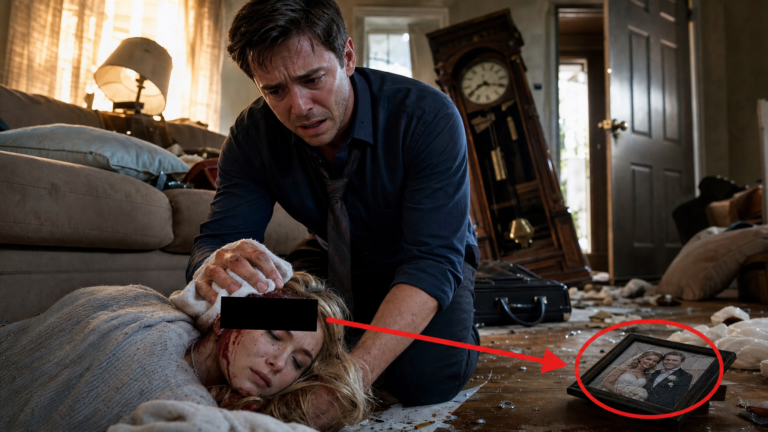
SFPD arrived in fourteen minutes. The arrest took another six. The charging document, which I read at three in the morning, used the phrase aggravated child abuse and administration of a controlled substance to a minor with intent to cause bodily harm. The prenup I had signed at twenty-nine had a forfeiture clause for felonies committed against family. Elliott had it invoked by noon.
Dr. Kellerman tapered Emma off the Baclofen over six weeks and put her on the correct Keppra dose — which turned out to be a dose she had barely needed in the first place. The seizure disorder was real but mild. Everything else — the weakness, the regression, the wheelchair — was drug effect.
Emma walked again on a Tuesday in October. She made it eight steps across the physical therapy room and sat back down laughing. I had not heard her laugh in four years.
Denise Hollis got her license back, a settlement, and a job at the children’s hospital on my foundation’s payroll. Her son Caleb — the boy with the plastic grocery bag — is on a full scholarship now. He writes Emma letters.
Victoria took a plea to avoid trial: eighteen years, no parole eligibility for twelve. The judge read the charging document aloud before sentencing. I watched the mask try to come back on her face one last time in the courtroom. It didn’t fit anymore.
Emma walked into that courtroom on her own feet.
I held the door for her.