The Girl with the Violin
The terrace at Aurelio’s catered to a particular kind of clientele—senators sealing engagements, founders closing rounds, bottles of wine priced like rent checks. White linen, crystal that held the sunset, a string quartet murmuring Vivaldi in the corner like background music nobody quite listened to.
Then a small girl slipped through the garden gate.
She couldn’t have been more than seven. Her feet were bare. Her dress, once pink, had faded to the color of dust and ridden up too high at the hem. Her hair was a tangle, her cheeks streaked with grime. In one hand she gripped a child-sized violin case that looked older than she did.
Margot, the hostess, spotted her first and crossed the terrace fast, heels snapping against the stone.
“Sweetheart, you can’t be in here. Where are your parents?”
The girl tilted her face up. Her eyes were enormous and very dark. “Please. I play. You give food?”
For half a second Margot’s expression softened—then the owner’s rules came back to her. “Honey, I’m so sorry. This is a private restaurant. Let me call someone who can help—”
“I play very good,” the girl cut in. Her voice was small but unwavering. “You listen. Then you choose.”
From table six, a regular named Harrison glanced up over his cufflinks. “Margot? Everything all right?”
“Yes, sir, I’m handling it—”
But the girl had already crouched and flipped open the case.
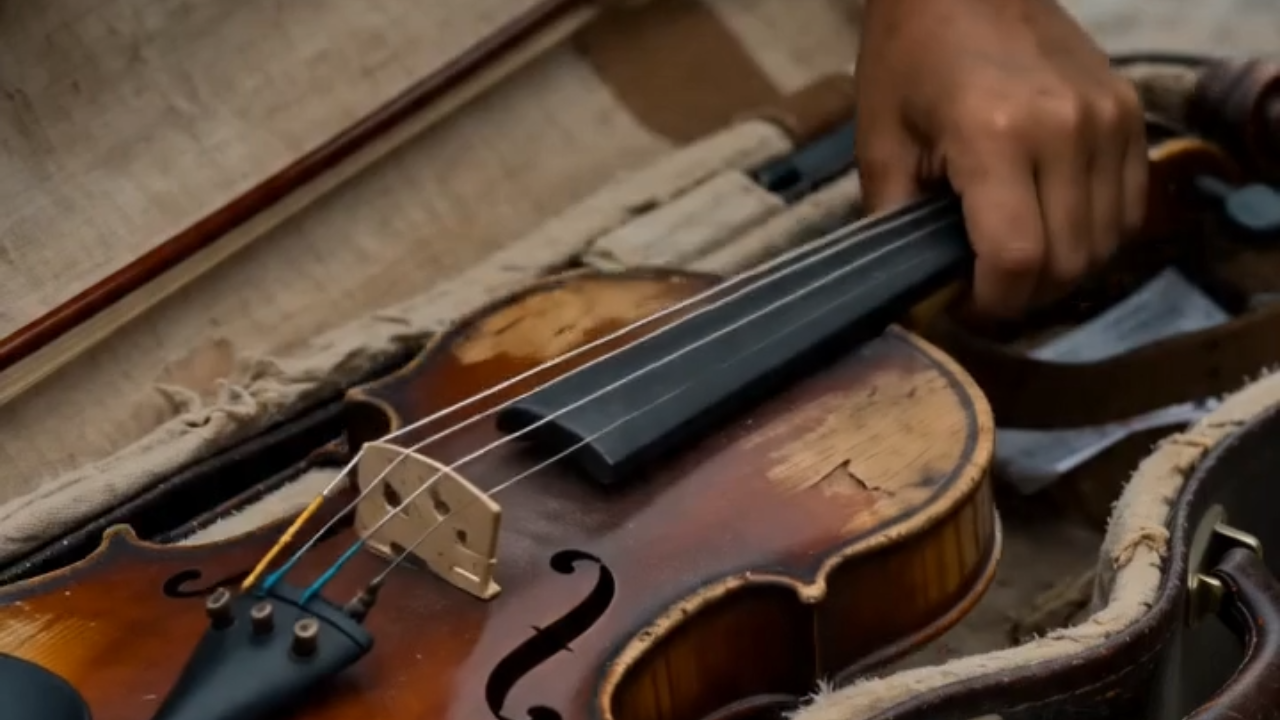
The violin inside was a wreck. Cracked varnish, a chinrest fastened with a wrap of electrical tape. Yet the moment she lifted it, she became someone else. Shoulders squared. Chin set. Her left hand settled on the neck like it had been waiting there its whole life.
She didn’t ask permission a second time.
She just played.
The first note rose long and clean and sliced clear across the terrace.
The quartet stopped mid-phrase.
A waiter froze with a tray of oysters balanced on his palm.
Harrison set down his wine and didn’t reach for it again.
What she played was slow and aching, a melody that seemed to come from somewhere children shouldn’t have to know about. Her eyes were closed. Her bow arm moved with a control that had no business belonging to a body that small. No vibrato at first—just the bare line of the tune, so naked it almost hurt.
Then the vibrato came in, and at table three a woman named Claudia pressed a hand over her mouth.
Margot stood completely still. Six years she’d worked here. She’d witnessed proposals and breakups and confessions across these tables. She had never heard a silence quite like this one.
The girl played for two minutes.
When the last note faded, she lowered the violin and opened her eyes.
For five full seconds, nobody moved.
Then Harrison stood. He walked over, pulled out his wallet, and held out two hundred-dollar bills.
The girl looked at the cash. Then at his face. “Food?” she whispered.
Harrison’s jaw flexed. “Yes. As much as you want.”
Margot finally found her voice. “Sir, I really don’t think—”
“Get her a table,” Harrison said, in a tone that didn’t invite a counterargument.
Margot hesitated, then nodded. “Of course.”
But before she could move, a man in a gray suit rose from table twelve. Victor Kane—local developer, locally infamous for getting his way.
He strolled over, hands in his pockets, smiling. “That was lovely, sweetheart. Really lovely.”
The girl didn’t smile back.
Victor crouched to her level. “Where did you learn to play like that?”
She didn’t answer.
His smile thinned. “I asked you a question.”
Harrison stepped forward. “Kane. Leave her alone.”
“Relax, Harrison. Just curious.” Victor turned to Margot. “Did you call anyone? Police? Social services?”
Margot blinked. “I—no, I was just—”
“You should. Child this age, no parents around? That’s neglect. She belongs in the system.”
Claudia was on her feet now, her chair scraping. “Or maybe she belongs with a hot meal in front of her before you start dialing.”
Victor raised his eyebrows. “I’m thinking of her safety.”
“You’re thinking of clearing the terrace,” Claudia shot back.
The girl’s eyes moved between them, her hands tightening around the violin.
Then the kitchen door swung open.
Anton Kress, the owner, stepped out. Sixty, silver-haired, with a face that didn’t show anything he didn’t want it to show. He’d been in his office in the back. He’d heard the music through the walls.
He walked straight to the girl.
The terrace went quiet again.
Anton looked down at her for a long moment. Then he knelt, ignoring what the stone was doing to the fabric of his slacks.
“What’s your name?” he asked, gently.
She hesitated. “Lina.”
“Lina.” He let the name settle. “That was Shostakovich. The second movement of the violin concerto. Yes?”
Her eyes widened. She nodded.
Anton smiled, and it was the saddest smile Margot had ever seen cross his face. “My daughter played that piece. She practiced it for two years.”
Lina looked at the floor.
Slowly, carefully, Anton reached out and touched the rim of the violin case. “May I?”
She handed it to him.
He opened it fully. Inside the lid, written in faded pencil: Property of Irina Koslov, 1987.
His hands stilled.
He looked back at her. “Where did you get this?”
“My mama,” Lina whispered. “She teach me. Then she go away.”
“Go away where?”
Her lip trembled. “I don’t know. Three weeks. I wait. She don’t come.”
Anton closed his eyes. When he opened them, they were wet.
He stood, still holding the case, and turned to Margot. “Set a table for her. Inside. Bring her anything she wants.” His voice had gone rough. “And call Elena.”
“Yes, sir.”
Victor stepped in. “Anton, you can’t just—”
Anton turned on him with a look that could have lifted paint off the walls. “She stays. If you’ve got a problem with that, the door is right there.”
Victor stared. Then he gave a tight smile, dropped cash on his table, and walked out.
Harrison exhaled. “Thank you.”
Anton wasn’t listening. He was looking at Lina. “Come with me.”
She followed him inside, small and silent.
Margot watched them disappear, then took out her phone and dialed.
Anton settled Lina at a corner booth, away from the noise of the terrace. He sat across from her.
“Are you hungry?”
She nodded.
He waved a waiter over. “Soup. Bread. Fruit. Don’t bring it all at once—her stomach needs to ease into it.”
The waiter slipped away.
Anton leaned forward. “Lina. Tell me about your mother. What’s her name?”
“Mama.”
“Her real name.”
She thought hard. “Anya. Anya Koslov.”
Anton went absolutely still. “Koslov.”
“Yes.”
He looked at the violin case again. His hand had a faint tremor in it now. “Irina Koslov was my wife. She died four years ago.”
Lina stared at him.
“She had a sister,” he said, voice tight. “Anya. We lost touch after Irina passed. I didn’t know—” He stopped. “I didn’t know Anya had a daughter.”
Lina’s eyes filled. “Mama say she have sister. She say sister marry rich man. She say maybe one day we find you.”
Anton’s face crumpled. “Why didn’t she call me?”
“She scared. She say you don’t remember her.”
“I would have—” He broke off and pressed his palms to his eyes. “I would have helped. I would have done anything.”
The soup arrived. Lina looked at it like it had fallen out of the sky.
“Eat,” Anton said quietly.
She ate—slowly at first, then quickly. He watched her, his jaw working.
A few minutes later the door opened. A woman in her forties walked in: Elena Marks, a social worker Anton had collaborated with for years on music programs in the shelter system. She took in Lina, and her face shifted into something careful and professional. She slid into the seat next to Anton.
“This is Lina,” he said. “She’s been on her own for three weeks. Her mother is my late wife’s sister. I didn’t know she existed until twenty minutes ago.”
Elena looked between them. “Do you want to take responsibility for her?”
“Yes.”
“It’s not that simple—”
“I don’t care,” Anton said. “I have the resources. I have the space. I’ll hire whoever needs hiring. She’s family.”
Elena studied him for a beat. Then she turned to Lina. “Honey, would that be okay with you? Staying with him while we sort things out?”
Lina looked at Anton. “You really her husband?”
He nodded. “I was.”
“She tell me about you,” Lina said. “Mama say you kind. She say you love music.”
His voice broke. “I did. I do.”
Lina turned back to Elena. “I stay.”
Elena sighed. “All right. I’ll start the paperwork. But Anton—I need to find her mother. We need to know what happened.”
“I’ll pay for a search. Private investigator. Whatever it takes.”
“I’ll make some calls tonight.” She squeezed Lina’s shoulder gently and let herself out.
For a while neither of them spoke. Lina finished the soup. Anton ordered her another bowl.
Eventually she looked up. “You really let me stay?”
“Yes.”
“I practice every day,” she said. “Mama say I have to. I don’t forget.”
“I know. I heard you play.”
“I good?”
“You’re extraordinary.”
She looked down at her hands. “Mama say if I play good, people listen. People help.”
“She was right.”
Lina raised her eyes, and for the first time, she smiled, just a little. “You help?”
Anton reached across the table and took her small, dirty hand in his. “I’m not going anywhere.”
Three days later, Elena called.
Anton answered on the first ring. “Did you find her?”
Her voice was measured. “We found a record. Anya Koslov was admitted to County General four weeks ago. Pneumonia. She’s still there.”
He stood up. “Is she—”
“Stable now. But she’s been asking for her daughter every day. Nobody knew where Lina was.”
He glanced across the room. Lina was on the couch, working her way through scales on the same battered violin. She’d been doing it every morning since she’d arrived.
“I’m bringing her.”
“I figured you would.”
County General was nothing like Aurelio’s—fluorescent lights, scuffed linoleum, the smell of disinfectant layered over exhaustion.
Anton held Lina’s hand as they walked the corridor. She wore new clothes now—jeans, a clean sweater—but the violin case was tucked under her arm.
They stopped at room 314. Elena was waiting outside. “She’s awake. Go ahead.”
Anton knocked, then eased the door open.
The woman in the bed was thin and pale, dark circles under her eyes. When she saw Lina, her breath caught.
“Lina—”
Lina ran to her. “Mama!”
They folded into each other, both crying. Anton stood in the doorway and watched.
After a long moment, Anya looked up.
The blood drained from her face. “Anton?”
He stepped inside. “Hello, Anya.”
She stared. “How—”
“Your daughter is very brave,” he said softly. “And very talented.”
Her hand went to her mouth. “She played for you.”
“She played for a lot of people.”
Anya looked at Lina, then back at him. “I didn’t know how to ask. After Irina died, I thought—”
“You thought I wouldn’t care.”
She nodded, tears running down her face. “I’m sorry.”
Anton pulled up a chair and sat. “Don’t. Not for this.”
She wiped her cheeks. “I got sick. I couldn’t work. I couldn’t make rent. I told Lina to wait in the park, that I’d be back in a few days—”
“You’re out now,” Anton said. “And the two of you are coming home with me.”
She stared at him. “Anton, I can’t—”
“You can,” he said firmly. “Irina would have wanted it. And I want it.”
Anya looked at Lina, who was gripping her hand.
“Mama, he has a big house,” Lina said. “And a piano. He say I can play whenever I want.”
Anya started crying again.
Anton reached for her other hand. “You’re family. You always have been.”
Six months later, the terrace at Aurelio’s hosted a private concert.
Lina stood in the center of it in a blue dress, holding a real violin now—professionally fitted, with a tone that made the evening air seem to shimmer.
She played the Shostakovich again. This time her mother was in the front row, healthy and smiling. Anton sat beside her. Elena had come. So had Harrison and Claudia. Even Margot was there, standing in the back with tears running down her cheeks.
When Lina finished, the applause went on a long time.
Anton rose and pulled her into a hug. “Your mother would have been so proud.”
Lina looked up at him. “Both of them?”
He smiled. “Yes. Both of them.”
She hugged him back, and for the first time in a long time, everything felt exactly right.